

1. TO STUDENTS, THEIR FAMILIES AND SCHOOLS
The University of Ferrara’s Training Programs
Teaching – along with Research – constitutes the core of the University of Ferrara’s activities, as well as the vehicle for the externalization of the social goals as contained in the University’s mission. High quality in teaching requires a strong engagement, both in terms of lectures and training courses and in terms of instruments and services for students, from educational guidance at the entry to assistance when accessing to the job market. Furthermore, high quality teaching needs the setting up of monitoring systems in order to verify the training programs’ responsiveness to student’s expectations and needs. In 2008, the University of Ferrara devoted particular attention to this last aspect. The University has, in fact, put into action several initiatives aiming at assessing students’ opinions on the perceived quality of training programs and services offered. Those initiatives have allowed the University to dispose of a precious set of information for the improving of the training programs.
The University’s Training Programs consist of 74 courses, 40 of which are Bachelors of Science (3 years), 33 Master of Science (“3 + 2” years) and 1 is a single 5-years-Master Degree Program. Training Programs are organized and managed by 8 Faculties: Architecture, Economics, Pharmacy, Law, Engineering, Literature and Philosophy, Medicine and Surgery, Mathematics, Physics and Natural Sciences.
In the academic year 2007/08, the enrolled students were 16.752, 9.318 of which were enrolled in the Bachelor of Science Study Programs, 6.064 in the Graduate Study Program, and 1.370 in the 5-year-University Program (Old University System).
45,9% of all enrolled students were men and 54,1% women; 67% of the enrolled students had passed their exams within the prescribed time, while 33% had not. The number of students enrolled in e-learning training programs was 1.029, 6.1% of the overall enrolled students.
Moreover, in the same academic year, graduated students were 2.741; 39,5% of them graduated within the prescribed time, while 27,8% did not (12,1% within a 2 years delay and 20,6% with more than a 2 years delay).
For the complete list of Training Programs and further details, please look at paragraph 4.1 of the Social Report.
Services to students
Students at the University of Ferrara are offered several services all along their study period. Those services are meant to preserve everybody’s right to high education and to improve quality of life within the University. Among the services delivered, particularly significant are those aiming at guiding and supporting students since their enrolment. In 2008, the Division “Services to students” and the Unit “Guidance, Promotion and Tutoring” obtained the ISO 9001 certificate for their Quality Management Systems (QMS). The QMS scope concerns all services designed for students, such as guidance when choosing the study program, international mobility, financial assistance, help for disabled persons, psychological support, study method support.
As for services meant to support students in their choosing of study programs, the University of Ferrara has developed several initiatives, both at its main seat and at single Faculties, with the objective of assisting students during their last years in secondary school. Every Faculty organizes initiatives, specifically designed in accordance to their own peculiarities and characteristics, ranging from orientation days, internships, open days, conferences, ad hoc meetings in schools, orientation tests, etc.
The main initiatives developed at the University central seat are: direct orientation counselling (front office, phone calls, etc.) and an annul Orientation Forum. In the academic year 2007/08 a new orientation initiative was introduced: the UnifeOrientati Project, carried out together with schools and supported by the Italian inter-university consortium AlmaLaurea. The students involved in the Project, all attending their last year at secondary school, were asked to fill in two different questionnaires (AlmaDiploma and AlmaOrientati), aimed at improving the University’s knowledge of the needs of the newly enrolled students.
The orientation initiatives for the e-learning courses include targeted and detailed communications sent to students requiring information on the website, as well as to those filling in the ad hoc form on the occasion of the Orientation Forum.
The orientation initiatives carried out during the course of studies intend to help students tackle problems that could interfere with their studies. Among them, two are especially worth mentioning: the Training Tutor and the SMS Service, this last one dealing with disability and offering psychological and method of study support. The Training Tutor service is carried out by either last year students or by graduates, in order to address any issue students may encounter during their studies. In the academic year 2007/08, Training Tutors were 155. The service is financed with ministerial funds related to the Law 170/2003.
Thanks to the same funds, in 2005 the University of Ferrara set up two other orientation tools. The first one, called Orientation Tutoring Service, was created in order to provide support to potential and newly enrolled students; the second one, called Erasmus Tutoring Service and introduced in 2008, intends to provide assistance to Erasmus students arriving at the University of Ferrara, offering them detailed information about training courses. In 2008, 11 tutors carried out the service, for a total of 450 hours.
As for the SMS Service, it offers three kinds of assistance:
- Disability service – the service is devoted to disabled students, providing them with the technical and training support needed to pass exams. Students can benefit from the support of a specialized tutor, whose duty is to remove all conditions and situations that may interfere with the students’ equal right to education and treatment;
- Method of Study – the service aims at supporting those students in need of help to achieve an efficient method of study;
- Psychological Support – the service is dedicated to those students who wish to solve personal problems considered to have a negative impact on their performance at University. Highly qualified professionals are available for students who need to address fears and distress, as well as to learn how to manage emotions, improve memory, etc.
In 2008, 138 students used the Disability service, while 274 used the Method of the Study and the Psychological Support services. All services mentioned above are delivered on demand, for free and under the privacy regulation.
Since 2005, moreover, a network of Training Managers is operating at the University of Ferrara, in order to improve the services related to training programs and to ease communication between students, teaching and the administrative staff. Thus, Training Managers operate as facilitators by supporting, on the one hand, the training and administrative management and, on the other hand, students.
The network consists of 17 Training Managers, all chosen by means of a public selection based on educational curriculum and qualification criteria. Coordinated by a single University Manager, Training Managers have the following main tasks:
- Providing students with information on training courses and training services offered by the Faculties, assuring an adequate coordination with professors and administrative staff;
- Contributing to the editing of training regulations and study programs;
- Providing assistance in the planning and management of training activities, in the orientation for newly enrolled students, in tutoring activities, as well as in services like international mobility, internships, etc.;
- Providing support in the quality assessment process for training programs as well as for the services offered.
Within orientation activities, the “Student Week” is dedicated to Multiculturalism. The initiative – in 2008 at its second edition – includes conferences, documentary films and sports events, all aimed at improving mutual understanding of the foreign students' various habits, food, and traditions.
The last set of orientation services to students are those designed to support graduates or last year students in their quest for a job. Among the existing services, the AlmaLaurea database, created and managed by the namesake inter-university consortium, gathers up and makes available on-line to companies the curriculum vitae of graduated students.
Together with the AlmaLaurea database, the University’s Job Centre has developed programs to guide and assist graduates entering the job market. In the academic year 2007/08 the Job Centre helped 1.834 graduates to find internships, 924 of them having a Bachelor of Science, 285 having a Master of Science, and 625 having a single 5-year-Master Degree.
Furthermore, thanks to the FIxO Program (Education and Innovation for Placement) – promoted and funded by the Ministry of Labor, and managed by Italia Lavoro together with the University of Ferrara – final year students and graduates have the opportunity to do their extra-curriculum internship within 18 months of their graduation, in order to strengthen their knowing of the labor market.
Finally, in December 2008 a desk for the consultation of the AlmaLaurea database was opened, thanks to an agreement signed with the consortium. The desk offers the following services: providing curriculum vitae to companies, publishing job offers and company descriptions, newsletters to advertise master and training courses. The service is a useful tool for the University of Ferrara to efficiently manage its relations with companies on the territory, and therefore be able to provide students with further traineeship opportunities.
A full description of services to students, as well as further information on the innovations introduced in those services, can be found in paragraph 4.2 of the Social Report. Services for international mobility are described in paragraph 7.3 of the Social Report.
Postgraduate Placement
The evaluation of training programs’ quality is best reflected by the indicator showing the percentage of graduated students that have found a job and within how long after graduation. The AlmaLaurea Consortium makes regular surveys on the graduates' placement rates for Italian universities. The following chart shows the results of the AlmaLaurea Survey for 2008. The data in the chart shows placement rates one year after graduation for students at the University of Ferrara having obtained their Bachelor of Science in summer 2005 – 2006 – 2007. These are then compared to the national average.
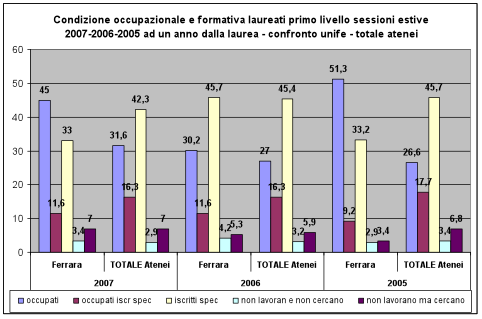
As for students who obtained an old university system Degree in 2007, the percentage of those among them who found a job within one year after graduation is 63%, higher than the percentage recorded in 2006 (53,9%) and in 2005 (57,3%). The average for Italian universities is 56,3%, therefore the University of Ferrara is above average as far as placement after graduation is concerned.
With regards to the University of Ferrara single 5-year-Master of Science 2007 graduates, the percentage of those employed (73%) is much higher than the national average (45,2%). Lower than the national average is, on the contrary, the percentage of graduates ‘not employed and not looking for a job’ (17,6% against 40,8%), as well as the rate of ‘unemployed graduates looking for a job’ (9,5% against 13,9%).
Finally, as far as Master of Science Degree graduates are concerned, 68,4% of those who have studied at the University of Ferrara have found and employment, more than the national average (62,2%). Higher than the national average too is the percentage of graduated students ‘non-employed and not looking for a job’ (18,4% against 17,4%), while the percentage of students ‘non-employed and looking for a job’ (13,2%) is lower than the national average (20%).
Among actions carried out by the Job Centre is the PIL Project (“Percorsi di Inserimento Lavorativo” – Work Placement Programs,) dealing with the creation of a labour market oriented training path for all undergraduates and post-graduates. The Project gives students the opportunity to work in a company or public institution with a one year contract and after going through a dedicated 6 months training program.
Since its start in 2001, the PIL Project has helped about 500 students to find a job, placed about 300 students and involved 190 companies.
The FixO Program (“Formazione & Innovazione per l’Occupazione” – Training and Innovation for Placement) was developed through four main actions:
- Job placement, to support and help placement services;
- Services to Business, aimed at creating work placement opportunities and traineeships for graduates, as well as at easing transition from university to the labour market;
- Technological Innovation, in order to train professional with specific skills in technology transfer to companies;
- Actions aiming at supporting academic spin-offs, to increase the value of and transfer academicresearch to the market by supporting highly innovative business ideas.
The FixO Project – action 2: ‘TIL – “Tirocini di Inserimento Lavorativo”- Placement oriented Internships’
Action 2 of the FIxO Project concerns the so-called Placement Oriented Internships (“Tirocini di Inserimento Lavorativo”) for students within 18 months of their graduation.
The University of Ferrara became part of the initiative in June 2007 and will continue to be involved until June 2009. 359 graduates have taken part in the Project (by means of Piattaforma Plus, set up by Italia Lavoro) and 195 of them have started an internship[1].
The FixO Project – action 3
A possible further evolution of the FixO Project is the “Apprenticeship for Higher Education” training program, made possible thanks to an official Protocol signed by the Emilia-Romagna Region and the Ministry of Labour. Thanks to the above mentioned Protocol, an ad-hoc Master Degree in “Building Site and Work Management” has been created, as well as a Master Degree in “Technology for Science and Management” (MaSTeM). The first was promoted by the Faculty of Architecture and Engineering and ended in 2008, while the second has been promoted by the Faculty of Science, Department of Chemistry.
The experimentation of the above mentioned training programs has led to the insertion of the latter in action 3 of the FIxO Project: “Promotion of training programs in the field of technology transfer and innovation for business for young unemployed graduates” Within this framework, three courses have been created, whose teaching method is based on the one used in the above mentioned Master Degrees. 90 students coming from all over Italy have enrolled and 60 local companies have been involved. The courses are the following:
- “Building Site and Work Management”, promoted by the Faculty of Architecture and Engineering; 30 companies have been involved, for a total of 42 job opportunities for placement (6 of which under a 2 years apprenticeship contract);
- “MasteM”, curriculum “Techniques, Technologies and Materials for the Environment”, promoted by the Faculty oh Mathematical, Physical and Natural Sciences, with the participation of 19 companies offering 36 jobs (2 of which under a 1 year contract);
- “Education and Human Resources Management”, promoted by the Faculty of Literature and Philosophy, with 18 companies involved and 22 jobs offered (2 of them being under a 1 year contract).
FixO action 4 – Actions aiming at supporting academic spin-offs
Within the framework of action 4 of the FIxO Project – aiming at supporting research by helping the development of academic spin-offs – in 2008 a partner in the University of Ferrara’s spin-off Verdenora s.r.l. proposed, together with the University’s Liason Office, a training program in Economy and Marketing, Commercial and Civil Law, and Intellectual Property Rights.
Lectures are due to be given in 2009 by professors of the Faculties of Economics and Law together with experts of a multinational company operating in the chemical sector.
The AlmaLaurea survey, the PIL Project and the FIxO Program are described in detail in paragraph 4.6 of the Social Report.
The Postgraduate Education
Postgraduate education is divided into three different training paths in order to diversify training programs and tailor them to the labor markets needs.
As for PhD., the University of Ferrara offers 16 courses in three major fields: Economics – law –classical – social studies; Medical – biological studies; Scientific – technological studies. In the academic year 2007/08, 405 students enrolled in a PhD Program, 102 men and 213 women. PhDs, as well as the related structures and services, are managed by the IUSS Ferrara 1391.
IUSS Ferrara 1391, the University of Ferrara main centre for PhDs, is described in detail in paragraph 4.4 of the Social Report.
Master and Specialization Courses offer students a more market-oriented training. 10 first level Master Degrees, 5 second level Master Degrees and 11 Specialization Courses were offered during the academic year 2007/08, for a total of 1.165 enrolled students. The above mentioned postgraduate training programs allow the University of Ferrara to achieve strong synergies between education and research, as well as to better meet industry and public institutions needs.
In the medical field, postgraduate programs includes 36 medical and 3 sanitary specialization courses, for a total number of 485 enrolled students in the academic year 2007/08.
Finally, postgraduate training programs offered by the University of Ferrara also include the “Postgraduate School for Middle School Teaching”. The School is aimed at students desiring to acquire the methodological, didactical and pedagogical skills necessary to work as a teacher. The SSIS School proposes courses in three major study areas: Natural Sciences Studies; Physics- Information Technology-Mathematical Studies; Human Sciences Studies; Economic-Law Studies; Motor Sciences.
In the academic year 2007/08, 371 students were enrolled in SSIS.
A detailed description of the postgraduate courses can be found in paragraph 4.3 of the Social Report.
Quality assessment of training programs and services
The monitoring of students’ opinion on the quality of their training programs is part of a larger quality assessment process carried out by the University of Ferrara. This process is a precious and useful source of information for the improvement of both accountability and quality of training programs. In 2008, the University of Ferrara conducted a quality assessment survey on training programs and services. The result was a overall satisfaction rating equal to 74,12%, slightly lower than the rating recorded in 2007 but higher than in 2006.
Furthermore, in 2008 the University of Ferrara carried out, for the third time in a row, a survey aiming at evaluating the doctoral candidates’ perceived quality of their training courses: in a range from 1 to 10, the students assessed the usefulness of training courses with a 6,9 rate.
Methodological approach and results of the survey are described in detail in paragraph 4.5 of the Social Report.
The Survey on the Library Services
In June 2008, the University of Ferrara carried out for the second year in a row a survey, by means of a paper questionnaire, aiming at assessing student’s satisfaction of library services. The survey involved 400 students, with a reply rate at around 83% (332 replies received, of which 47% from men, 52% from women, and 1% of “does not reply”).
The results show a high utilization rate of libraries: about 70% of students declare to make regular use of the library, 33% of which on a daily basis. In particular, results show that students go to the library not only to borrow books but also to browse the library’s catalogue. Few students, on the contrary, go to the library to make use of the reading rooms.
As far as the library’s collection is concerned, the survey has shown that student’s perceived quality is consistent with their expectations, both for paper and electronic resources.
With regards to the webpage of the Library System, results have shown that online services are widely known and frequently used (in particular for catalogue and general information browsing).
Paragraph 4.5 of the Social Report contains a detailed description of the survey’s results on library services.
The Survey on the Admission Office
In May 2008, the University of Ferrara polled students’ perceived quality of the services offered by admission offices. The survey was carried out by means of a paper questionnaire, (distributed and then collected by the University’s Training Managers) and involved 1.600 students, 200 for each Faculty. Altogether, students assessed the quality of the services given by the admission offices, as well as the staff's competence and courtesy, as being in-between “sufficient” and “good”.
The detailed description of the Admission Office survey’s results can be found in paragraph 4.5 of the Social Report.
The Library’s opening times in the evening
At the end of 2005, the University of Ferrara signed an Agreement with the Regional Authority for the Right to Education and the Zanotti Foundation, in order to implement a series of services aiming at meeting both students’ study and free time needs as well as easing socialization. As continuation of the above mentioned collaboration, in January 2008 a new agreement was signed between the University and the Zanotti Foundation. Thanks to this agreement, some reading rooms of the Faculty of Medicine’s library can now be open until 23 from Wednesday to Friday. On Saturday opening times have been extended to 9 to 18.
|
Library of the Faculty of Medicine (136 places) - Attendences recorded in reading rooms in 2006-2008 |
|||
|
|
Attendances recorded |
Evening Average Attendances
|
Saturday Average Attendances |
|
Total attendances 2006 |
5.261 |
34 |
57 |
|
Total attendances 2007 |
7.727 |
45 |
52 |
|
Total attendances 2008 |
8.225 |
43 |
57 |
|
NOTES - Service Management: Zanotti Foundation; - Beginning of the service: March 2006; - Period March-July 2006 opened from Monday to Thursday 17-22,30; - Period September - December: opening on Wednesday, Thursday and Friday, 17-23; Saturday 9-18.
|
|||
Evening opening times of Libraries are described in paragraph 9.6 of the Social Report.
[1] 6 internships have been activated in January 2009.
