

5. … AND TO FERRARA’S PEOPLE
Ferrara as a City Campus
One of the University of Ferrara strategic goals is that of improving and spreading the image of Ferrara as a city for students, by increasing the value of its historical and scientific heritage (laboratories, libraries and museums). In this perspective, following some selected experiences in Europe, with the project “City for Students – Città Universitaria”, the University has integrated its expansion plans within the city urban development and renewal plans.
The project has been possible thanks to the agreement with local public institutions, as stated in the University Statute. The Statute envisages the creation of a “Supporters Committee”, whose members also include city representatives such as the Mayor. City institutions are also represented in the University’s new Board of Directors.
The platform for scientific and technological activities is represented by the network of “Centers” where training, research, technology transfers and production innovation activities are performed. The Center for Cultural Heritage and the Chemical and Biomedical Department (Life Science Centre) are located within the city medieval walls.
The other Centers are located outside the city walls: the Scientific and Technological Campus on the site of the former Eridania factory, the Agro-industrial and Environmental Campus in the town Malborghetto di Boara, the Department of the Clinical Research and Aid (Life Science Centre) in the town of Cona.
Besides the scientific and technological platform, the University also reserves a series of spaces and facilities for students, Professors and Researchers welcoming and assistance, as well as a Sport Centre in the city park.
Finally, the above mentioned platforms are to be considered as integrated with Ferrara cultural and medical care services that qualify it as a “city of culture and knowledge”.
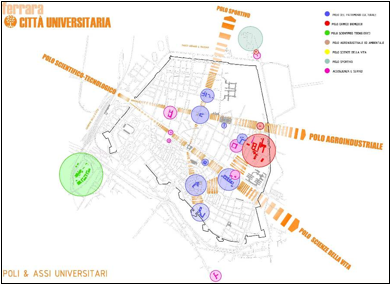
The detailed description of the “City for Students” Project can be found in the paragraph 6.6. of the Social Report.
The Project “Cultural Heritage”
The University has been for a long time looking at cultural heritage as an important component of its relation with the territory and society. In 2006, this led the University to the creation of an ad hoc research team for a specific project called “Project Cultural Heritage”. The initiative was aimed at creating an integrated and multidisciplinary research branch on cultural heritage, in order to promote initiatives and innovative research activities.
In 2008, the cultural heritage research team continued and strengthened its engagement in the activities started in 2007. In particular, the Departments of Architecture, Biology and Evolution, Economics, Engineering, History and Earth Sciences continued their studies, researches and cooperation in preparation of an important congress held on the 30th March 2009. The meeting, whose topic was “Skills and Instruments for Cultural Heritage on Ferrara’s territory. An interdisciplinary research perspective”, took place in cooperation with the University’s Supporters Committee and contributed in the definition of the main guidelines behind the team’s activities for cultural heritage:
- strengthening the University role in terms of know-how production and transfer;
- directly interacting with the territory, by promoting cooperation not only with local communities and scientific institutions, but also with institutional stakeholders.
For further details on the Project “Cultural Heritage” please look at paragraph 9.2 of the Social Report.
The University Museums
In 2006, The University of Ferrara launched a project for the management and enhancement of its Museums and Archives. In order to achieve this goal, the University established a “University System of Museums and Archives”. The system, created in 2007 and operating under strict coordination with teaching and research activities, is composed of three Centers, each with specific functions:
- Palazzo Gulinelli – the Book and Archival Centre;
- Palazzo Turchi Di Bagno – the Museum, devoted to temporary and permanent expositions;
- Polo Scientifico-Tecnologico – The Museum Teaching Centre.
In order to enhance its historical and cultural heritage, the University has begun an accurate survey of it. The survey project will allowed the University to verify the correspondence between its actual possessions and what is recorded in the database.
The “P. Leonardi” Paleontological and Prehistoric Museum (the former Department of Earth Science Museum) has been the first to be reviewed. The Museum was established in 1964 in the Palazzo Turchi di Bagno when the Institute of Geology was moved into it from its former location in via Previati.
|
Schools’ visits at the P. Leonardi Museum |
||||||
|
|
year 2002/03 |
year 2003/04 |
year 2004/05 |
year 2005/06 |
year 2006/07 |
year 2007/08 |
|
Number of schoolchildren that have visited the Museum |
834 |
929 |
663 |
894 |
1.433 |
595 |
The 3 year review project will continue in 2009 with the review of the “Instruments Collection of the Department of Physics”, composed by more than 200 scientific instruments of high interest for museum purposes and at the moment located in the scientific and technological campus.
A detailed description of the University Museums can be found in paragraph 9.3 of the Social Report.
The University’s medical facilities and research activities
Thanks to research, the University is continuously engaged in the enhancement of its medical know-how and related outcome on teaching and medical assistance activities. In the last years, the University has been investing remarkable resources for the improvement and development of its competences in several scientific fields. This has been possible thanks to several important research centres, such as:
- The Service and Research Centre for Menopause and Osteoporosis. – The Centre, established in 1998, is part of the Department of Biomedical Sciences and Advanced Therapies – Section of Gynaecology of the University of Ferrara – and currently located in spaces outside the hospital made available by the Ferrara’s AUSL (Local Health Authority). The Centre’s activities are mainly related to menopause and post-menopause osteoporosis. The Centre published more than 300 scientific works so far.
- The Centre for Vascular Diseases – Established in 2004, the Centre carries out interdisciplinary activities for research on vascular diseases and degenerative diseases involving the vascular system. Research, prevention, medical education, vascular system diseases diagnosis and therapy, and services to public and private partners are the Centre’s core activities. The Centre operates for the rehabilitation of arteriopathic patients, for the study of complex vascular malformation associated to severe pathologies such as multiple sclerosis, for genetic hemodynamic diagnostics and for the development of mini - invasive treatments.
- The Interuniversity Centre for Excellence in Oncologic and Palliative Treatments Communication (CIRECO) in cooperation with the La Sapienza University in Rome – Established in 2008, the Centre is a reference for Master Degrees trainings and research in the oncologic and palliative treatments field, with important results on patients and medical staff. The Centre promotes and coordinates research activities on the psychological, psychobiological and psychopathological consequences of oncologic pathologies. In particular, the Centre focuses on communication aspects as well as aid to patients (ex. radiotherapy, surgery, oncology and haematology).
The University research project in the medical field
As far as research is concerned, the University of Ferrara operates in the following fields: stamina cells, pharmaceutics, nanotechnologies for the treatment of deafness, vascular diseases and degenerative diseases involving the vascular system. Among current projects the following is worth mentioning:
- “National multicentre random controlled study for the non-inferiority assessment of the Busenide/Formoterol association in case of necessity for asthmatic patients with respect to the Busenide/Formoterol association taken regularly 2 times a day together with terbulatine”
The project is the result of the University of Ferrara’s proposal of a new clinical protocol presented to the Italian Pharmaceutical Agency (Agenzia Italiana del Farmaco – AIFA) and approved in 2006. The research project involves 31 Italian centres – 20 universities and 11 hospitals – and is coordinated by the University of Ferrara’s Clinic for Breathing Apparatus Diseases. The Project aims at assessing the efficacy of an inhaling therapy to use only in case of necessity and the possibility to substitute it for the regular daily therapy for moderate bronchial asthma.
The research project stems from growing worries in the international scientific community about the side effects associated with the regular use of inhaling drugs.
- The Nanoear Project
Since 2006, the University’s Research Laboratory for Hearing Protection, Plasticity and Regeneration has been involved in the European Nanoear Project for the study of nanotechnologies for deafness treatment. The Project deals with the production and use of nanoparticles (NPS) able to act on defined targets. In particular, the Project aims at creating particles coated with molecules able to concentrate drugs, genes and stamina cells’ action on the cells to treat. Furthermore, the molecules-coated particles are biodegradable, easy to track in vivo and able to control the release of the substances they carry. To that end, several research teams with different skills are taking part in the Project’s phases. These latter are the following:
- Nanoparticles production;
- Tests to assess toxicity, biodegradability and in vitro release;
- Tests to assess toxicity, release and in vivo traceability.
In 2007 the University’s Laboratory conducted toxicity tests on about 20 NPS (created with various materials) using rats’ pheochromocytoma cells (PC12). The Laboratory used morphologic and cytofluorimetry techniques. Only one material type resulted to be positive and in 2008 the Laboratory started the analysis of the same NPS associated with drugs.
In particular, the Laboratory carried out the up-take analysis for the NPS. This latter was intended to verify which kind of cells is responsible for the internalization and the possible accumulation and release of these NPS.
The tested nanoparticles were associated either with fluorophores (necessary to carry out the up-take) or viral (TAT) and mimetic peptides (TrkB) (necessary for the internalization guiding and strengthening). To date, the research has shown that NPS tend to entre via endocytosis and that toxicity varies depending on time and quantity. So far there is no evidence showing the existence of a relation between internalization and peptides.
A detailed description of medical facilities and research activities can be found in paragraph 10.2 of the Social Report.
